


Mold & Mycotoxins in Children: The Deep Dive
Updated: Sep 24
You've done everything right. You changed the diet. You pulled the screens. You tried the thing a friend swore by. You've seen the pediatrician, the specialist, maybe two. And your child is still struggling in a way that does not quite add up, and nobody can tell you why.
This is the piece I most often find missing, and it is the one nobody can see. I wrote a high-level overview on my mold and mycotoxins page. This is the deeper dive for the parent who wants to understand why mold affects one child and not another, how I test for it, and where the healing actually starts.

Frequently asked questions
Short answers first. The full reasoning is below.
Can mold cause ADHD or behavior problems in children?
It can contribute. In sensitive kids, mycotoxins drive inflammation in the gut and brain and disrupt the brain's signaling, which can show up as focus trouble, mood swings, anxiety, irritability, or restricted eating — often labeled "behavioral" when there's a biological driver underneath.
How is mold toxicity different from a mold allergy?
A mold allergy is an immune reaction to mold spores — the sneezing-and-itchy-eyes response. Mold toxicity is the body's response to mycotoxins, the chemical byproducts mold releases. A child can have a normal allergy workup and still be affected by mycotoxins, which is exactly why this gets missed.
Can my child be affected if the rest of us feel fine?
Yes. The same home can affect each person differently depending on genetics, detox pathways, gut health, nutrition, and age. One child struggling while everyone else feels fine doesn't rule mold out.
How do you test a child for mold and mycotoxins?
Two questions guide it: is it in the home, and is it in your child. A dust test screens the home; urine mycotoxin testing and antibody testing look at exposure and your child's immune response. I read them together, in context, rather than as a single yes-or-no.
Are binders necessary to detox from mold?
Not routinely, in my approach. I focus on healing the gut so the body can handle much of its own detoxification, and I avoid binder-heavy protocols that can deplete an already-struggling child. This is individualized — what's right depends on the specific child.
Mold versus mycotoxins: the distinction that changes everything
When most people hear mold, they picture an allergy. Sniffling, itchy eyes, a cough. That is real, and for some kids it is the whole story. But it is not the part I worry about most.
What I pay attention to is mycotoxins, the chemicals certain molds release to protect themselves. Mold is a living organism. Mycotoxins are toxins. In a sensitive child, those toxins do not show up as a runny nose. They show up in the gut and the brain.

That one distinction is why mold gets missed so often. The allergy test comes back unremarkable, the environment gets crossed off the list, and the toxin piece- the part actually driving the symptoms- was never looked at.
Why children are more vulnerable
Children are not small adults. A growing brain is more vulnerable to inflammation. The systems that clear these toxins out are still maturing. Kids breathe faster for their size, spend more time low to the ground and indoors, and have less margin when their body is already carrying a load.
Damp, moldy homes are consistently linked to more coughing, wheezing, asthma, and respiratory infections in children. That part is well established. The part that gets less airtime is what mycotoxins do beyond the lungs: laboratory work shows they damage the intestinal barrier, and they drive inflammation in brain tissue.
In the children I see, that can look like anxiety, focus trouble, sensory overwhelm, sudden rigidity around food or a shrinking food list, brain fog, irritability, rage that arrives out of nowhere, or sleep that simply will not hold. Those get called behavioral. I look for the biology underneath. This overlaps heavily with what I cover in why behavior is biology and the root causes behind ADHD.
Why one child gets sick, and the rest seem fine
This is the piece I most want you to sit with, because it is the reason mold gets ruled out too early.
First, mold does not have to be visible. The kind that matters most grows out of sight. Behind a wall, under a floor, inside an HVAC system, from a leak that dried years ago. A home can look and smell completely normal and still carry a real exposure.
Second, and this is the part that surprises families most, the same house can affect each person in it differently. One child reacts hard while a sibling seems unbothered and a parent feels fine. That is not proof the house is clean. That is biology. How a body handles mold depends on its detox pathways, its genetics, its gut health, its nutrition, its age, and how long it has been carrying the load. Some kids clear these toxins efficiently. Others hold onto them, and that is where the symptoms pile up.
This is where genomics earns its place in my work. The genes that govern methylation and detox, the ones I look at through genomic testing and write about in my blog, help explain why two children under the same roof can have such different outcomes. Your child's genes may set the stage, but they don't write the script.
So when a parent tells me the house looks spotless and everyone else feels fine, I do not hear a reason to rule mold out. I hear a reason to look closer.
How mold drives symptoms: the gut connection
Here is the mechanism in plain language, because understanding it changes how you will think about everything that follows. The reason something in the air ends up changing a child's behavior is that it runs through the gut.
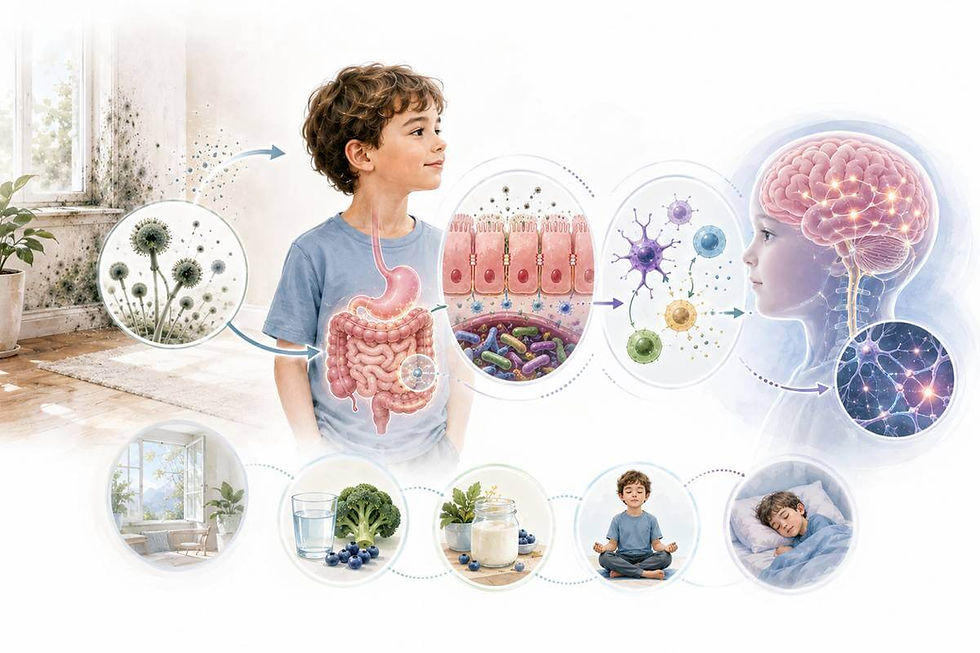
When mycotoxins reach the gut, they damage the lining. The barrier that is supposed to keep things out starts letting things through, which is what you may have heard called a leaky gut. Laboratory studies show mycotoxins pulling apart the junctions between gut cells directly. Once that barrier is loose, inflammatory particles, including bacterial byproducts called endotoxins, slip into the bloodstream and travel to the brain.
Mycotoxins also feed yeast overgrowth and tip the microbiome out of balance, which keeps the whole cycle going. Your gut, your immune system and your brain are all closely linked. When the gut is out of balance, the ripples show up everywhere else. I unpack the foundational version of this in why the gut drives immunity, behavior, and focus.
Why these kids react to everything
When the gut is inflamed and the immune system is on high alert, a child becomes hyperreactive. To foods, to supplements, to environments, to the very things meant to help. Parents describe a kid who cannot tolerate anything, who flares on the supplement that helped last month, whose food list keeps shrinking.
That is not stubbornness and it is not your imagination. It is an overwhelmed system. When I meet a child who reacts to everything, the environment is one of the first places I look.
The mast cell and histamine piece
That hyperreactivity often runs through mast cells, the immune cells that release histamine. Mycotoxins trigger mast cells, which is why mold and histamine problems so often travel together, and why a mold-affected child can look like they have histamine intolerance on top of everything else.
The overlap with PANS and PANDAS
Mold does not always act alone. In some children, it is one of the environmental triggers behind a sudden, dramatic shift: the abrupt onset of OCD, tics, anxiety, rage, handwriting that falls apart, or restricted eating that defines PANS and PANDAS.
The published consensus framework for PANS is built around exactly this idea: that a trigger sets off an immune response that does not shut off. If your child's story includes a sudden, out-of-nowhere change, mold belongs on the list of things to consider.
Signs worth paying attention to
No single sign confirms anything, and many of these have other explanations. But when several cluster together, especially in a child who has not responded to everything else, the environment moves up my list.
Brain fog, slowed processing, or a drop in focus that doesn't fit your child's intelligence
Mood swings, anxiety, irritability, or rage without a clear trigger
Sudden rigidity around food, a shrinking food list, or restricted eating
Sleep that won't hold: trouble falling asleep, night waking, restless nights
Chronic congestion, postnasal drip, or "sinus infections" that don't respond to antibiotics (often these aren't purely bacterial)
Stomach trouble: constipation, loose stools, or highly variable digestion
Headaches, joint or muscle aches, or fatigue that rest doesn't fix
Skin issues like eczema or hives
Sensory sensitivities that seem disproportionate to sound, texture, or clothing
Symptoms that don't fit together, or aren't responding to appropriate care
A history of water damage, leaks, or a musty smell anywhere your child spends time
If you are reading this nodding, you are not imagining it. That pattern is worth a real conversation.
Before any testing: the Foundational Five
I do not lead with a test panel, and you should be wary of anyone who does. Before I order anything, I want the Foundational Five in place: sleep, airway, nutrition, hydration, movement.
Here is why that is not a stalling tactic. A child who is short on sleep, mouth breathing all night, running on carbs alone and barely drinking water will look inflamed and reactive no matter what the house is like. Get those steady first and you find out how much of the picture is actually environmental. Testing comes after, and only when there is a real question left that a test can answer.
There is one exception. If there is visible mold or a musty smell where your child sleeps, deal with the house now rather than waiting.
Testing: how I actually find it
I think about testing as two questions, and the honest answer usually needs both. I will also be candid about the limits, because mold testing is still something of a wild west, and a result you do not know how to read can send you the wrong direction.

Step one: Is it in the environment?
A dust test analyzes the DNA of mold in the settled dust of a home, which acts as a long-term record of what's been in the air. The most widely known version is the
ERMI (Environmental Relative Moldiness Index), developed by EPA researchers, which screens for dozens of mold species and flags the ones tied to water damage. A simple at-home option many families start with is The Dust Test, you collect dust at home, send it in, and get a read on what's present. (That's my referral link for The Dust Test.)
A word of honesty. A dust test is a starting point, not a verdict. It can pick up outdoor mold that drifted in, and it cannot tell you where a problem is hiding. A concerning result is a signal to bring in a professional inspector who can find and confirm the source. Think of it as the flashlight that tells you it is worth opening the door, not the inspection itself.
Step two: is it in your child, and is their body reacting?
This is where exposure and immune testing come in, and each one is a different lens.
Urine mycotoxin testing: for example, the Mosaic Diagnostics MycoTOX profile measures what your child's body is actively clearing out. It's a useful screen for ongoing exposure.
Serum mycotoxin antibody testing: such as MyMycoLab. When mold is part of the picture, the instinct is to hunt down the specific mycotoxin and attack it. That approach looks at whether the immune system is making antibodies to mycotoxins, which speaks to whether the body is reacting, not just whether exposure happened.
Mold immunoreactivity panels, such as an Alletess mold panel, measure IgE, IgG, and IgA responses to specific mold species, separating an allergic reaction from a deeper immune one.
Reading them together
Here is the part most testing pages will not tell you. One result rarely tells the whole story, and a normal result does not always mean there is nothing there. Some children store these toxins rather than clear them, which can make a urine test look quieter than the child in front of me. Urine results also move with diet, not only with the house, and studies measuring mycotoxins in children's urine find them commonly, largely from food.
That is exactly why I do not chase one number. I read these lenses together, alongside your child's whole picture, and let the home test and the body tests inform each other. Interpretation is the work, and it belongs with a provider. Testing, not guessing.

A gut-first path forward
When mold is part of the picture, the instinct is to hunt down the specific mycotoxin and attack it. That approach creates more complexity than it solves. The path that actually moves children forward is gut-first, and it mirrors the foundational work I do with every family, mold or not. I am keeping this at the framework level on purpose. The specifics are individualized in a consult and are not something to start on your own.
First, bring the inflammation down. Before anything else, I focus on settling the inflammation and the mast cell reactivity that mycotoxins drive, using support chosen and dosed for the individual child, so the system stops reacting to everything.
Then, seal and heal the gut barrier. Our priority is to heal and seal the gut, because nothing else lands while the gut is leaking. The aim is to repair the lining, restore the minerals these toxins deplete, and rebuild a healthy microbiome.
Next, address yeast and overgrowth gently. When testing or the clinical picture calls for it, prescription antifungal support, always prescribed and monitored, can help interrupt the cycle. Gentle is the operative word. The goal is an environment where the gut can heal and good bacteria can come back, not to scorch everything at once.
A note on binders, meaning the activated charcoal and clay protocols you will see all over the internet. I have moved away from using them routinely. When you truly take care of the gut, the body handles a great deal of its own detoxification, and binders can interfere with nutrient absorption in kids who are already depleted. This is a live conversation in the field, and a reminder that more aggressive is not the same as more effective.
Finally, and this one is not optional: remove the source. You cannot fully heal the gut while your child is still being exposed. If testing points to the home, the next step is a professional assessment to find it and remediate it.
The order of operations matters more than any single product, which is why clearance comes before binders in mold recovery.
When it's more than functional medicine
Functional medicine works in conjunction with your child's other care, not as a replacement for it. If your child is in crisis, is not eating or drinking, or has a medical emergency, that needs urgent medical attention right away. And confirming and remediating mold in a home is the work of a qualified inspector and remediation professional, not something to guess at. My role is to look at the whole child, connect the dots, and walk alongside you.
How I help, and where to start
I do not hand families a generic mold protocol. Those overwhelm an already-sensitive child, and a lot of functional medicine practices get a bad rap for exactly that. I start by getting the full picture: your child's story, their gut, their genomics, their environment, and how it all fits together.
From there, we build something that fits your child and the life your family is actually living, and I stay in it with you. If you have felt for a long time that something biological is driving what everyone else keeps calling behavioral, and you have wondered about the environment, book a consult and let's look at it together. I see families in person in Omaha and by telehealth across Arizona, Colorado, Iowa, Nebraska, Tennessee, and Virginia.

You are not failing your child, and you are not overreacting. There is no judgment here in looking for more answers. If the air has been the missing piece, finding it is often the moment everything else finally starts to move. And I will never accept or tell a parent this is just how it is, because more often than not, that is not true.
Written by Dr. Amy Patton, Founder, Happy Kid Functional Medicine
Get Clarity and Learn More.
When you are ready for help, my mold and mycotoxins service page, including how guided testing starts, is the next step.
About the author
This article was written by Dr. Amy Patton, DNP, APRN, CPNP-PC, FMACP, a board-certified pediatric nurse practitioner and functional medicine provider serving Omaha-area families through Happy Kid Functional Medicine. Dr. Patton specializes in root-cause pediatric care for children's gut health, sleep, behavior, nutrition, immune patterns, and whole-child wellness. She sees patients in person in Omaha and by telehealth across Arizona, Colorado, Iowa, Nebraska, Tennessee, and Virginia.
References
Medical disclaimer: This article is educational and is not medical advice. It does not diagnose, treat, or replace individualized care from your child's pediatrician or licensed medical provider. Supplement types, doses, and combinations should be selected with a qualified clinician who knows your child's full history; never start a new supplement based on a blog post alone. Always consult your pediatrician before making changes to your child's routine, and seek prompt medical care for snoring with gasping or pauses in breathing during sleep, or for any severe, sudden, or concerning symptom.


Comments