


Stool, breath or organic acids: which test answers what?
Updated: Sep 2
You have been handed three test names and no plain way to choose between them. Stool test. Breath test. Organic acids. Each one comes with a kit, a price and a promise. None of them comes with one clear sentence about what it actually answers.

Here is that sentence, three times, plus the table I wish someone had handed you first.
What do parents ask me most about this?
Short answers first. The full reasoning is below.
What does a stool test show in a child?
A stool test shows what is living in your child's large intestine right now. The Tiny Health PRO gut test is my standard one.
What does a methane breath test show?
A methane breath test shows whether your child's gut is producing methane, the gas most closely tied to a slow bowel.
What does an organic acids test show?
An organic acids test reads chemical byproducts in your child's urine. The Organic Acids Test from Mosaic Diagnostics shows neurotransmitter patterns tied to regulation, mitochondrial function and energy production, and metabolic patterns.
How do these three gut tests compare?
Here is how the three gut tests compare side by side. The Tiny Health PRO gut test reads who is living in the large intestine.
Which gut test should I start with?
I start most families with two panels, not one and not three. Gut testing plus the Organic Acids Test is the option that gives the most bang for the buck.
Do I need all three gut tests at once?
No. Two panels chosen on purpose beat three panels chosen out of worry. We are not trying to do everything at once.
What do these gut tests not tell me?
None of these three gut tests diagnoses a disease, and none of them replaces standard blood work. Nutrient status, inflammation, iron stores, thyroid panel and immune function come from conventional labs through Quest or…
Does my child need a blood draw for any of this?
Not to start. Both of my first-line panels are collected at home: stool for the Tiny Health PRO gut test, urine for the Organic Acids Test.
What does a stool test show in a child?
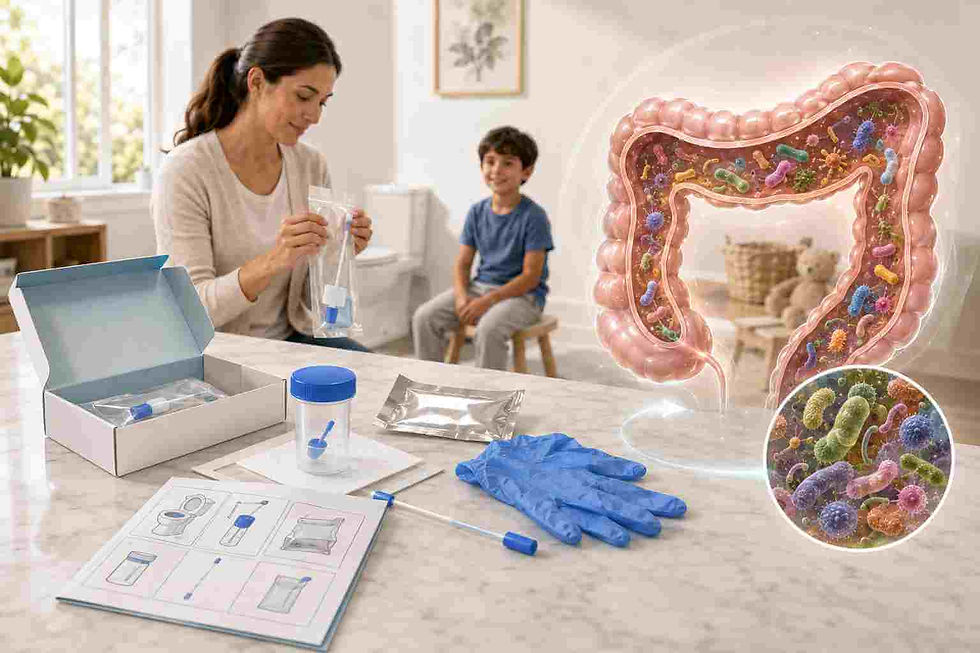
A stool test shows what is living in your child's large intestine right now. The Tiny Health PRO gut test is my standard one. It reads the bacterial mix, the overall diversity, a gut score, yeast, bacteria, and parasites, and measures of gut lining integrity from a sample you collect at home. No needles, no lab visit, no fasting.
I use the Tiny Health PRO gut test rather than repeating an older stool panel. The gut microbiome can change considerably over time, and I find the Tiny Health testing provides a very detailed look at where a child is now. A child's gut community is also still assembling for years, so it has to be read against other children rather than against adults.1
What a stool test cannot do is see the small intestine. Stool comes from the far end of the trip. So a stool test tells me a great deal about balance and variety, and very little about gas being made higher up.
What does a methane breath test show?
A methane breath test shows whether your child's gut is producing methane, the gas most closely tied to a slow bowel. Your child drinks a measured sugar solution, then breathes into collection tubes over about two hours. Methane is the gas that slows the bowels down, and no stool test will tell you that.
The link is well documented. Methane slows transit through the intestine and changes the way the small intestine contracts.2,3 Pooling nine studies, methane on breath testing was about three and a half times more likely in constipated subjects. The more methane produced, the more severe the constipation tended to be.4,5 North American consensus counts methane of 10 parts per million or more as a positive result.6
The honest limits matter here. Breath testing is inexpensive, simple, and safe, but it is an indirect measure of what is happening upstream.6,7 The pediatric gastroenterology committee that reviewed this in 2025 was blunt. There is still no universally accepted definition of bacterial overgrowth in children. Every available test, breath testing included, carries real limits and pitfalls.8 So I order breath testing when the picture points at slow transit, not as a routine first move.

What does an organic acids test show?
An organic acids test reads chemical byproducts in your child's urine. The Organic Acids Test from Mosaic Diagnostics shows neurotransmitter patterns tied to regulation, mitochondrial function, and energy production, and metabolic patterns. It also shows clues or hints of possible mold or yeast overgrowth. All of it without a blood draw.
Measuring organic acids in urine is not fringe chemistry. It is the long-standing method medicine uses to diagnose and follow inherited metabolic disorders.9 The Organic Acids Test runs that same analysis and reads it with a different question in mind.
That is also where its honest limit sits. The same organic acid can come from a metabolic pathway, from food, from a medication, from gut bacteria, or from how the sample was handled.9 A single raised marker is a clue. It is not a conclusion. I read an organic acids test as a pattern next to the child in front of me, never as a verdict pulled off one line of a report.

How do these three gut tests compare?
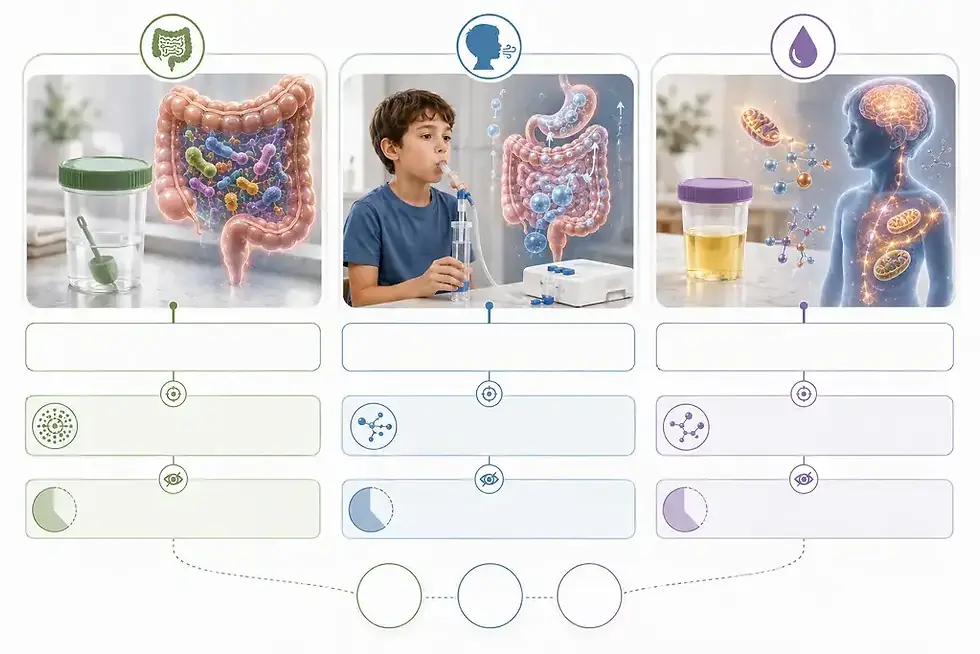
Here is how the three gut tests compare side by side. The Tiny Health PRO gut test reads who is living in the large intestine. A methane breath test reads one gas tied to slow transit. The Mosaic Organic Acids Test reads metabolic and brain-chemistry byproducts in urine. Different samples, different questions, different blind spots.
Tiny Health PRO gut test
Sample: Stool, collected at home
What it answers well: Bacterial mix, microbial diversity, gut score, yeast, bacteria and parasites, gut lining integrity, Bifidobacterium infantis levels
What it does not answer: Gas production, the small intestine, brain chemistry, mold exposure, nutrient status
When I reach for it: First panel for almost every child with gut symptoms
Methane breath test
Sample: Breath, collected over about two hours after a sugar drink
What it answers well: Whether methane is being produced, the gas tied to slow transit
What it does not answer: Which organisms are present, gut lining, nutrient status, brain chemistry
When I reach for it: Constipation that will not shift, or gas and bloating out of proportion to the stool report
Mosaic Organic Acids Test
Sample: Urine, collected at home
What it answers well: Neurotransmitter patterns, mitochondrial and energy markers, metabolic patterns, yeast and fungal markers, hints of possible mold
What it does not answer: Which bacteria are present, gut lining integrity, whether methane is high, a mold diagnosis
When I reach for it: Paired with the stool test when focus, behavior, sleep or energy are part of the picture
Which gut test should I start with?
I start most families with two panels, not one and not three. Gut testing plus the Organic Acids Test is the option that gives the most bang for the buck. My recommendation is usually to start there, because it gives us the broadest starting picture and it avoids a blood draw right away.
The second pairing I offer is gut testing plus mold blood testing. Mold moves up the list when the story calls for it: water damage at home, a musty basement, a school building, or symptoms that started after a move. That is when I reach for mold and mycotoxin testing instead. The trade-off is real, because the most specific mold panel is drawn from blood. If you want the background first, I have written about mold and mycotoxins in children.
Book My Free 15-Minute Call Free. No obligation. Not a sales call.
The right test depends on the pattern: constipation, dysbiosis, or a leaky lining, which is it helps you name the pattern first.
Do I need all three gut tests at once?
No. Two panels chosen on purpose beat three panels chosen out of worry. We are not trying to do everything at once. More data collected in the same week does not give you a clearer picture. It gives you a longer report, a bigger bill, and the same question about which finding is driving the day you are actually living.
There is a sequencing reason too. Some findings decide what the next test should be. If the stool panel and the story point at slow, methane-leaning transit, breath testing becomes worth doing. If they don't, it usually isn't.
What do these gut tests not tell me?
None of these three gut tests diagnoses a disease, and none of them replaces standard blood work. Nutrient status, inflammation, iron stores, thyroid panel and immune function come from conventional labs through Quest or Children's Nebraska. Those are answers that simply cannot come from stool testing alone.
None of them hands you a clean number for the gut lining either. Tests of the gut barrier measure different pieces of it, they don't always agree, and every result has to be read with those limits in view.10 Anyone telling you a single panel proves a leaky gut is selling certainty the science does not have yet.
And none of them tells you what to do. A report is a map. The plan is a separate conversation, and it depends on your child's age, history, current medicines, and what your family can realistically handle.
This is why I never run everything at once; here is how I choose labs for a child instead of running everything.
Does my child need a blood draw for any of this?
Not to start. Both of my first-line panels are collected at home: stool for the Tiny Health PRO gut test, urine for the Organic Acids Test. For a 4-year-old, I usually try to be thoughtful about whether we truly need a blood draw right away, and most of the time we don't.
A blood draw earns its place when the question needs it. The MyMycoLab mycotoxin panel is the most specific way to look for past and present mold exposures, and the downside is that it requires a blood draw. Conventional blood work is the same trade-off. I would rather ask your child for one draw that answers something real than three that were ordered to look thorough.
You did not come here to become an expert on lab panels. You came because something is off and you want a real map instead of guesswork. Two well-chosen tests give you that map. Three give you a longer report and the same uncertainty.
Pick the two that answer your child's actual question. Then we read them together, in order, and you finally get to see what you have been looking at all this time.
If you want help choosing between them for your own child, that is exactly what a first call is for. You can also see what each panel covers on my page for pediatric gut and microbiome testing. Or read how the whole approach fits together and what a natural pediatrician does.
Book My Free 15-Minute Call Free. No obligation. Not a sales call.
Written by Dr. Amy Patton, Founder, Happy Kid Functional Medicine
About the author
This article was written by Dr. Amy Patton, DNP, APRN, CPNP-PC, FMACP, a board-certified pediatric nurse practitioner and functional medicine provider serving Omaha-area families through Happy Kid Functional Medicine. Dr. Patton specializes in root-cause pediatric care for children's gut health, sleep, behavior, nutrition, immune patterns, and whole-child wellness. She sees patients in person in Omaha and by telehealth across Arizona, Colorado, Iowa, Nebraska, Tennessee, and Virginia.
References
Yatsunenko T, Rey FE, Manary MJ, et al. Human gut microbiome viewed across age and geography. Nature. 2012;486(7402):222–227. PubMed
Pimentel M, Lin HC, Enayati P, et al. Methane, a gas produced by enteric bacteria, slows intestinal transit and augments small intestinal contractile activity. Am J Physiol Gastrointest Liver Physiol. 2006;290(6):G1089–G1095. PubMed
Triantafyllou K, Chang C, Pimentel M. Methanogens, methane and gastrointestinal motility. J Neurogastroenterol Motil. 2014;20(1):31–40. PubMed
Kunkel D, Basseri RJ, Makhani MD, Chong K, Chang C, Pimentel M. Methane on breath testing is associated with constipation: a systematic review and meta-analysis. Dig Dis Sci. 2011;56(6):1612–1618. PubMed
Chatterjee S, Park S, Low K, Kong Y, Pimentel M. The degree of breath methane production in IBS correlates with the severity of constipation. Am J Gastroenterol. 2007;102(4):837–841. PubMed
Rezaie A, Buresi M, Lembo A, et al. Hydrogen and methane-based breath testing in gastrointestinal disorders: the North American Consensus. Am J Gastroenterol. 2017;112(5):775–784. PubMed
Pimentel M, Saad RJ, Long MD, Rao SSC. ACG clinical guideline: small intestinal bacterial overgrowth. Am J Gastroenterol. 2020;115(2):165–178. PubMed
Puoti MG, Assa A, Benninga MA, et al. Small intestinal bacterial overgrowth in children: an expert review by the ESPGHAN Gastroenterology Committee. J Pediatr Gastroenterol Nutr. 2025;81(4):986–999. PubMed
Kumps A, Duez P, Mardens Y. Metabolic, nutritional, iatrogenic, and artifactual sources of urinary organic acids: a comprehensive table. Clin Chem. 2002;48(5):708–717. PubMed
Galipeau HJ, Verdu EF. The complex task of measuring intestinal permeability in basic and clinical science. Neurogastroenterol Motil. 2016;28(7):957–965. PubMed
Medical disclaimer: This article is educational and is not medical advice. It does not diagnose, treat, or replace individualized care from your child's pediatrician or licensed medical provider. Supplement types, doses, and combinations should be selected with a qualified clinician who knows your child's full history — never start a new supplement based on a blog post alone. Always consult your pediatrician before making changes to your child's routine, and seek prompt medical care for snoring with gasping or pauses in breathing during sleep, or for any severe, sudden, or concerning symptom.


Comments